The Role of LIMS in Streamlining Sample Tracking
How Does a LIMS Improve Sample Tracking?
Here’s a simple—but revealing—question:
Do you know exactly where every lab sample is in your testing process right now?
For many laboratories handling complex workflows, the honest answer is no. And it’s not due to poor processes—it’s because traditional tools simply aren’t built for the job.
A Laboratory Information Management System (LIMS) improves sample tracking by giving every sample a unique digital identity, assigning it a real-time status, and moving it through workflow-specific queues from intake to completion. This helps laboratories reduce manual tracking errors, prevent lost or forgotten samples, improve chain of custody, and speed up sample turnaround time.
Why Sample Tracking Breaks Down
Modern labs operate in highly dynamic environments, where sample tracking becomes a constant balancing act between science and logistics.
You’re not just running tests—you’re also:
- Managing sample intake and labeling
- Updating tracking systems (often spreadsheets)
- Coordinating across teams and workflows
And in many cases, all of this falls on the same person.
Why Spreadsheets Are Not Enough for Lab Sample Tracking
Many labs start out tracking samples in Excel or Google Sheets because those tools are easy to use, familiar to most teams, and relatively inexpensive. In smaller environments, spreadsheets can get the job done. But as testing volumes increase and workflows become more complicated, spreadsheets quickly become difficult to manage.
The Problem with Spreadsheets
Relying on Excel spreadsheets for sample tracking creates immediate operational challenges:
- Files become outdated quickly
- Manual data entry introduces errors
- Visibility across teams is limited
- Version control becomes difficult
- Lack of traceability – no secure audit trail
- Processes do not scale with lab growth
- Data is often stored across disconnected systems
What begins as a simple tracking method can quickly turn into a fragmented process that increases inefficiencies and risk. Instead of maintaining a controlled and traceable workflow, laboratories often find themselves reacting to missing information, communication gaps, and preventable mistakes.
The Complexity of Modern Sample Workflows
Today’s testing environments introduce multiple layers of complexity:
- Multi-day testing cycles – a single sample may take days to test, with multiple people processing each sample (challenging to follow the chain of custody).
- Complex workflows – an end-to-end testing process may include a dozen complex processes and procedures for any given sample and sample type (and most labs don’t have an effective tracking solution).
- Concurrent sample batches – multiple batches of samples are commonly tested in a lab at any given moment (and may lack the proper identifiers to track each laboratory sample batch).
- Strict timing requirements and data quality risks – sample integrity and data quality are at stake if a sample is not processed within an appropriate timeframe (all processes, from sample collection to processing of test results, impact data quality and metrics).
Without a centralized system, maintaining accuracy and traceability becomes nearly impossible.
How a LIMS Transforms Sample Tracking
Implementing a LIMS for sample tracking is like tagging every sample with its own reliable GPS. LIMS software replaces manual tracking with a structured, automated approach that assigns each sample a unique digital identity.
With a LIMS, you can:
- Track every sample across its entire lifecycle
- Centralize all sample data in one system
- Automate status updates and workflows
- Eliminate reliance on manual tracking tools
What is Queue-Based Sample Tracking?
At the core of effective LIMS functionality is queue-based sample tracking.
How It Works
Each sample is assigned:
- A unique identifiable tracking number (so it’s never confused with another sample)
- A status that reflects its current stage
The tracking number tells you which sample is which— and this is necessary because all tubes and plates look the same. The status is a simple, relatively descriptive term that makes it easy for anyone to know where the sample is in the process quickly. Some examples of status terms are: “Released for Testing,” “In Testing,” “Testing Complete,” or “Re-Testing Needed.”
With a configurable LIMS such as Lockbox, users can even customize status fields to align with their laboratory’s unique processes and terminology.
A LIMS provides an individual queue for each significant step in your sample testing process. Samples are listed on an appropriate queue based on their status. As you complete one portion of testing and are ready to move on to the next, the LIMS automatically updates the status of every relevant sample. For instance, a status may change from “In Testing” to “Testing Complete.”
You can also display additional sample tracking data in the queue, such as receipt dates, to help prioritize which samples to test first. For example, teams can quickly sort and identify the oldest samples in the queue, making it easier to prioritize testing workflows, maintain efficiency, and improve turnaround times.
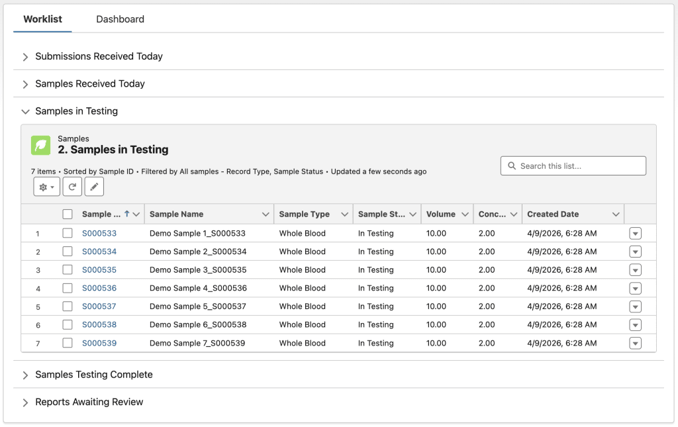
Below is an example of a Lockbox LIMS Worklist queue, which tracks and manages samples throughout the sample processing workflow. This specific worklist has collapsed lists that when expanded, will display a list of samples in each stage of the workflow. Here the “Samples in Testing” status is expanded and details —such as number, name, type, status, volume, concentration, and creation date—are displayed.
Built-In Safeguards That Prevent Errors
A robust LIMS enforces best practices through automation:
- Mandatory status assignment ensures that every sample entering the system is properly tracked from the start. By requiring a status for each sample, laboratories can maintain complete visibility throughout the workflow and significantly reduce the risk of samples being misplaced or lost.
- As testing continues, every sample remains in a queue until its testing is fully complete.
- The LIMS will automatically update the status of the samples in each queue. This is a critical step in preventing errors that surface when users manually adjust sample status.
These built-in safeguards significantly reduce human error, improve data reliability, and streamline sample tracking workflows—making the days of worrying about forgotten or misplaced samples a thing of the past.
Key Benefits of LIMS-Driven Sample Tracking
- Accuracy: When status updates rely solely on manual data entry, mistakes are inevitable—whether it’s updating the wrong sample, overlooking a status change, or forgetting to make an update altogether. Automated status tracking reduces these risks, helping laboratories maintain reliable, real-time visibility into every sample throughout the testing process.
- Precision: With queue-based sample tracking, no sample will ever remain overlooked, untested, or forgotten halfway through testing. Every sample is tracked from intake to completion—no gaps.
- Efficiency: Teams spend less time managing samples and more time analyzing results.
- Speed: Faster turnaround times with clear, actionable workflows.
The Bottom Line
Sample tracking shouldn’t be a bottleneck—or a guessing game.
A LIMS with queue-based tracking transforms your lab operations by delivering:
- Complete visibility
- Reliable data
- Streamlined workflows
In today’s modern lab environment, automated sample tracking is no longer just a helpful tool—it’s a critical component of an efficient, accurate, and compliant laboratory.
Contact us and book a demo to see how Lockbox LIMS can bring clear, accurate, and efficient sample tracking to your lab. We’ll be happy to show you how it works.
It’s time to explore how Lockbox LIMS can work for you and allow you to return your focus to science.