The Role of Quality Change Control in Laboratory Information Management Systems

Why Is Change Control in LIMS Critical for Lab Compliance?
Across nearly every regulated industry, from running lab tests and manufacturing medical devices to producing food products and developing new drugs, one operational discipline shows up again and again as mission-critical: tracking every change, every time. In life sciences, including biotech, medical devices, pharmaceuticals, and testing laboratories, change control isn’t just good practice. It’s the backbone of a strong compliance program.
Change control is the formal process of documenting, reviewing, approving, implementing, and tracking changes to laboratory processes, software, methods, documents, and/or equipment. Effective change control ensures every modification is evaluated, properly authorized, and fully traceable throughout its lifecycle.
Consider a familiar scenario: a lab updates a concentration value, but the change isn’t documented with a timestamp, reviewer, or justification. Months later, an auditor asks why the original value was changed and who approved the update, but the lab can’t provide a complete history. What began as a routine correction becomes a documentation gap, and those gaps can turn a routine inspection into a finding. This is exactly the type of scenario change control and a complete audit trail are designed to prevent.
Most commonly, these changes are captured and documented through an audit trail. This is why a flexible, user-friendly Laboratory Information Management System (LIMS) with robust audit trail capabilities is one of the most important systems a laboratory can implement to support data integrity, traceability, and compliance.
Understanding why change control carries so much weight makes it clear why an effective LIMS isn’t simply another laboratory application; it’s a foundational component of a modern quality and compliance program.
A LIMS Is Essential for Effective Laboratory Change Control
Ask any experienced auditor what tops their checklist, and change control will be near the very top. It’s the foundation many regulatory frameworks are built on, and inspectors often look for change-related documentation and retention first.
Failing to track and document changes, maintain file integrity monitoring, or retain records for the required time period can lead directly to inspection findings, delayed approvals, or worse.
While regulatory compliance is one of its primary purposes, change control also improves operational consistency and product quality. It’s also fundamental to good change management overall:
- Product and Process Consistency: Every undocumented change is a source of variability.
- Customer Trust: Your customers rely on you to deliver consistently high-quality products and services, batch after batch, year after year.
- Root Cause Analysis: When something goes wrong, a complete change history is often the fastest path to understanding why.
In a regulated organization, change control touches nearly every function, including but not limited to:
- Document control
- Software change control
- Process control
- Calibration
- Inventory control and materials management
- Protocol management
Most commonly, these changes are captured and documented through an audit trail, and this is why a configurable, intuitive LIMS with strong audit-trail capabilities is one of the most important systems a laboratory can implement. Trying to manage change control through spreadsheets, paper logs, or disconnected tools introduces exactly the kind of gaps and inconsistencies that inspectors are trained to find.
Lockbox LIMS Audit Trail Capabilities
Third Wave Analytics’ Lockbox LIMS comes out-of-the-box with a robust LIMS field history that tracks 20 files per object, and the historical data is retained for 18 months.
By default, every object and record in Lockbox can be configured to display key system metadata, such as the owner, created date, and time of the last modification, giving your team immediate visibility into recent activity. Each record also comes with a complete audit trail that captures which users changed field data, when the change occurred, and the previous and new value.
For organizations that need deeper traceability, Lockbox’s change control software can be configured to:
- Capture change log history for up to 200 data fields, including both previous and current values, with the optional Enhanced Field Audit Trail add-on.
- Store that history indefinitely, using the optional Enhanced Field Audit Trail add-on.
- Encrypt audit trail data to help meet HIPAA and GDPR requirements.
- Generate exportable reports that let you quickly present change metrics and audit trail data during an inspection, rather than scrambling to compile it manually.
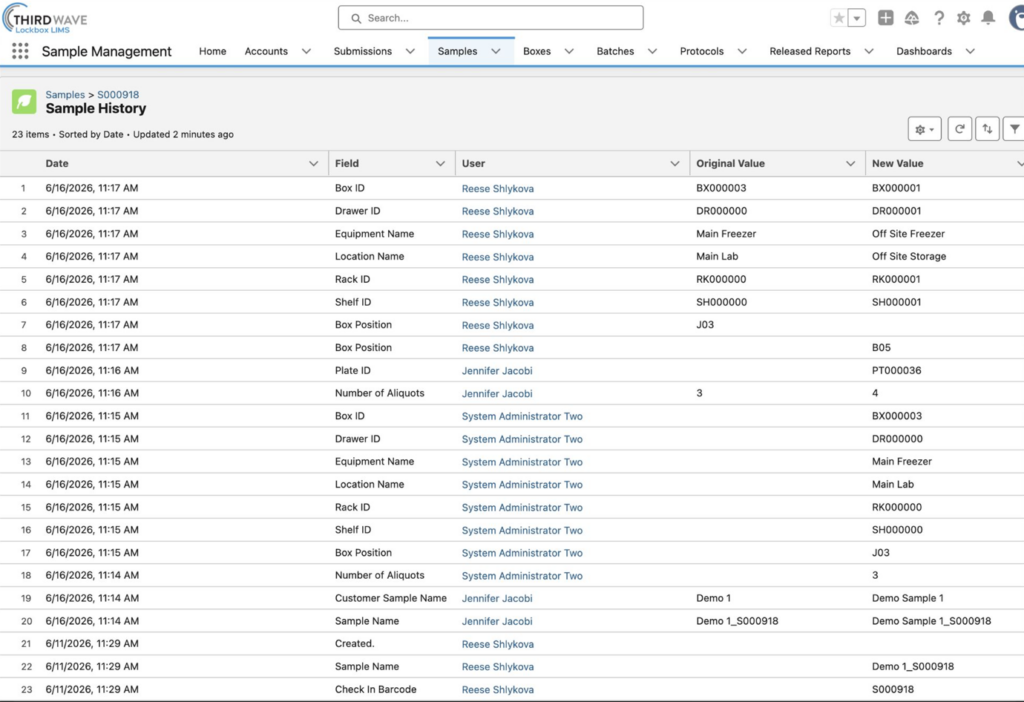
In practice, this means a user with the appropriate permissions can pull up any data record (a sample record, for example, in Figure 1) and fully reconstruct every action ever taken on it. If an error is discovered, the original values are right there, making it easy to quickly restore them rather than trying to reconstruct what the record used to say. The result is complete traceability: you always know what was changed, when it happened, and who did it.
That last point matters more than it might seem. During an inspection, the speed and clarity with which you can produce audit trail evidence often shapes an auditor’s overall confidence in your quality systems, not just their assessment of that one data point.
Real-World Example
“We had our annual ISO 9001 audit last week. The auditor started by asking various questions and then finally got to one where a member of our team could segue into showing her Lockbox LIMS, her response was ‘Oh, you should have shown me this first! It would have eliminated a lot of my initial questions.’ We passed our audit without any major observations, and Lockbox LIMS played a big role in that.”
Rebecca Friend, Director of Operations
Prairie Tide Analytics
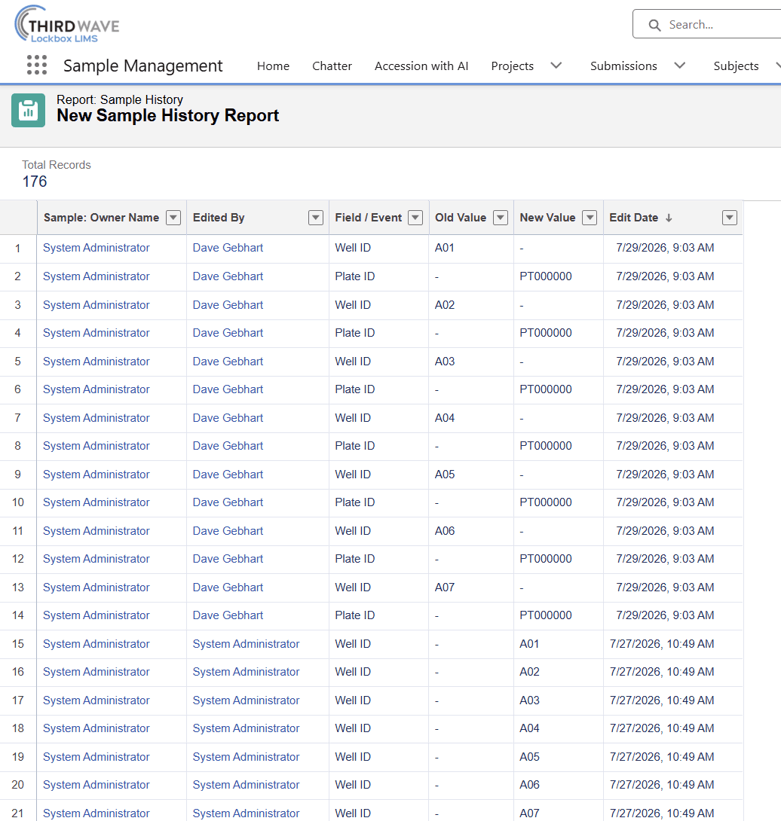
Lockbox LIMS also makes it easy to create reports showing all of the changes for an object over a certain time period, as shown in Figure 2. This gives you a laboratory-wide view of changes happening and which users are making the changes.
Built by a Company That Practices What It Preaches
Your Quality Assurance team can also rest easy knowing that Lockbox itself is developed under the same rigorous quality and change management discipline you’re expected to maintain. At Third Wave Analytics, we take quality seriously. Not as a checkbox, but a core part of how we build software.
Our Quality Management System (QMS) is designed to produce a product that’s ready for validation in FDA, CLIA, HIPAA, GDPR, and ISO environments. In practice, that means Lockbox is:
- Design-controlled
- Change-controlled
- Version-controlled
Every change to the system, no matter how small, goes through risk assessment, documentation, and testing before it’s ever released to customers. This isn’t a marketing claim; it’s a process our own QA team lives by daily. Third Wave utilizes GAMP 5 methodology to verify and regression test every component of our managed package. We also offer Vendor Verification Consulting services, so your team stays audit-ready during Lockbox upgrades or whenever you’re adding new functionality to your LIMS.
The Bottom Line
Change control isn’t a paperwork exercise; it’s the mechanism that protects product quality, customer trust, and regulatory standing all at once. A LIMS built with strong audit trail capabilities takes what could be a manual, error-prone burden and turns it into a reliable, defensible system that’s ready for inspection at any time.
It’s time to explore how Lockbox LIMS can work for you and allow you to return your focus to science.